



When I last shared my thoughts around this world in which we all find ourselves, I focused on a volatile job market and imparted my best advice stemming from my year-long search for a job. In the nearly two years since, the job market has remained volatile as layoffs have continued. This is due in large part to another seismic shift that has begun to upend everything we know about how Operations functions. I’m talking about AI, of course.
The function of AI in our sprawling industry has invited many use cases, opinions, and swift actions that have affected entire teams and how we all work together. When the AI push first began, I had serious doubts about the viability of Operations, my field of choice. Now that I’ve lived it for the past two years, I can say this with no doubt:1
Operations are more important than ever before.
When I talk about Operations, I’m drawing from my experience working across the product development lifecycle in addition to go-to-market (GTM) operations. My career has centered mainly in Design Operations, but I’ve had stints in Product Operations, GTM, and Technical Program Management. No matter the speciality, I’m steadfast in this belief that companies should be growing their ops teams, not shrinking them.
What AI has allowed all of us to do is summarize, work faster, and build more effectively and efficiently (or vibe code as is the current buzz phrase). AI has not replaced what teams need in order to adopt new practices, adapt to changes, and make decisions. Some companies have cited AI as a reason to eliminate entire teams, claiming that it will increase efficiency and reduce the need for human capital. I can’t predict every stock market turn, but from what I’ve experienced, AI alone will not move the needle as much as people hope.
That’s not to say that AI won’t play a big role in shaping the future, it already has. But the link between AI and increased productivity and profitability is and will always be, humans.
So where does Operations fit into this new AI equation? As a supercharged partner that can help craft operating models and frameworks, summarize information and drive decisions, and build plans that can move quickly and more efficiently. This allows us humans space and time to focus on the more difficult counterparts:
Adoption. Connection. Culture.
I’ve used AI to help build frameworks and systems that previously took me months as I navigated disparate tooling, processes, and organizational layers. AI doesn’t make navigating those challenges any easier, it simply allows me more time and brainpower to spend on solving them. AI is the tool. Humans are the architects.
Ops teams function like any other team in a Product or GTM organization. Humans craft, determine business impact, and make tough decisions when faced with a bevy of information. These teams have always utilized any number of tools to do the work required to achieve those results.
The hammer does not wield itself.
I have learned to embrace the utility that AI provides while taking on the same challenges that companies always have and always will. Here are six core learnings since I’ve adopted AI into my daily work:
1. If your organization doesn’t allow your tools to talk to each other, you are already behind.
Your tools must talk to each other. With AI, it’s easier than ever to connect tooling across teams. I can connect Airtable to Jira to a Wiki to Figma to Claude and so on and so forth. I can do all of this with the help AI to help build the right frameworks and connection points. People like me still need to architect how this can happen, AI just allows us to build it. But without the permissions for AI to read and write to your tools or even the tools being able to connect to one another, Ops teams will still have to manually connect processes and information. Don’t let that be a barrier. Furthermore, if your organization hasn’t even settled on what tools it uses, it’s not just behind, it’s still at the starting line. AI can’t create help build something out of nothing.
2. If you don’t have a decision framework, you won’t make fast decisions, or any decisions at all
A team can build all the prototypes, quick experiments, and user journeys they want, but unless you have clear distinctions for decision makers, you won’t act fast enough with enough conviction to utilize that ability to make more informed decisions.
3. AI should encourage experimentation, not stymie it.
AI allows us to create tangible use cases that can be put in front of actual people to get actual feedback. AI can then help summarize and create themes from that feedback to allow our teams to steer toward user-centered design and development. If we AI to build excellent prototypes but then sit on them for months, we’ve wasted the potential to stay relevant to our customers.
4. There should never be a human taking notes for you, ever again.
Every human in the room or attending the meeting should have a purpose for being there, and that purpose never again has to be for note-taking, summarizing, or action items. Operations should be there to drive the purpose of the meeting, get the right people in the room, and enforce the decision framework that should’ve been crafted already.
5. Information should be centralized, searchable, and easy to summarize.
Don’t waste your teams’ valuable time searching for the right context. Keep all your files, decisions, risks, designs, releases, etc in a centralized place. At the very least, use that connected tools framework you already built to sync information so that everyone is on the same page.
6. Focus human energy on the human things
Have your operations teams help build culture, encourage broad thinking, and create team trust. These are foundational tenets of your organization that provide some form of stability through all of the organizational shifts, strategic pivots, and attrition. Building these core values allow your teams to avoid fragmentation and fire at moving targets together.
AI has helped create some of the most useful and powerful products and tools I’ve seen in my nearly two decades in this industry. But at the end of the day, tools are created by humans and used by humans. And without human operations, none of the promises of AI will ever come to fruition.2
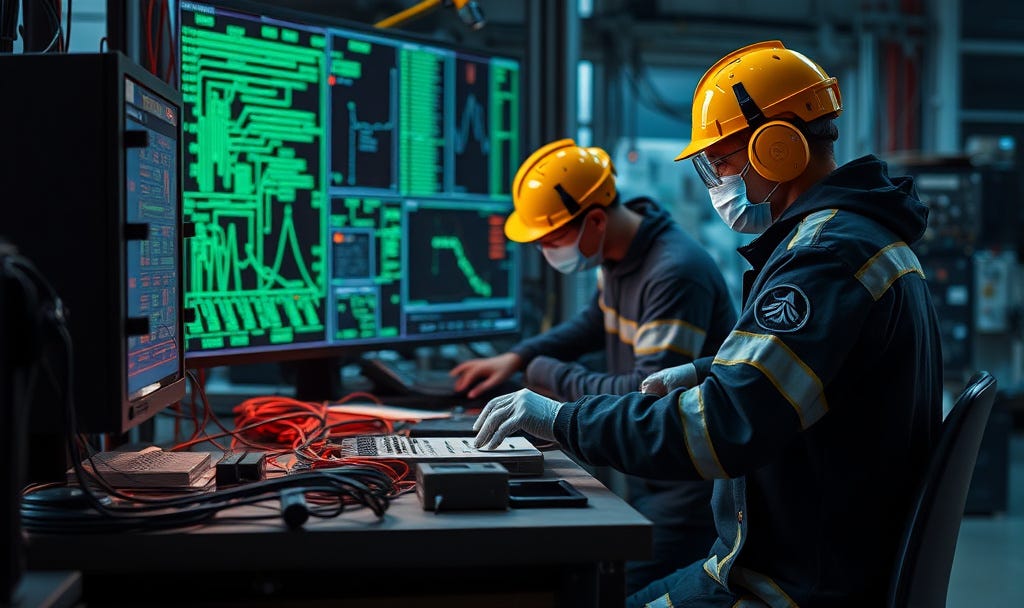
The two images in this article were produced from the same search terms., one is a stock image created by a human and the other is generated by AI. Can you tell the difference?
This article was written without AI and was edited by a human.